WP Consent API and GetTerms

What is WP Consent API and how does it help you keep your WordPress website compliant?


If you’ve ever stared at your email list wondering whether you’re one complaint away from a hefty fine, you’re not alone. The General Data Protection Regulation (GDPR) has been a source of anxiety for marketers since it came into force in May 2018, and understandably so.
But here’s what the doomsayers got wrong. Done right, GDPR makes you a better marketer, helps build trust with subscribers, and creates a foundation for long-term email marketing campaigns success.
This guide cuts through the jargon and gives you a practical, plain-English roadmap, from understanding the core principles to fixing your opt-in forms and handling your existing list compliantly, even with marketing automation.
Here at GetTerms, we use MailerLite for our newsletter, and we love it. So, we thought it fitting to collaborate with their team to demonstrate how to keep your email marketing efforts GDPR compliant. Kasturi Patra is going to show you the ropes.
Disclaimer: This article is for informational purposes only and does not constitute legal advice. Please consult a qualified legal professional to understand how GDPR applies to your specific situation.
Privacy Policy, Cookie Banner, Terms = Sorted!
Get startedThe General Data Protection Regulation (GDPR) is a comprehensive European Union data privacy law, enforceable since 25 May 2018. Its core mission is to give individuals control over their personal data and hold organizations accountable for how they use it.
For email marketers specifically, GDPR changed the rules of engagement. Before it came into force, it was common practice to pre-tick consent boxes, bundle newsletter sign-ups into terms of service agreements, or simply assume that a customer’s email address was fair game for marketing. GDPR closed all of those doors. But in doing so, it also opened something more valuable: a direct line to people who actually want to hear from you.
Here’s why that matters for your business beyond avoiding fines:
Inbox providers like Gmail and Outlook use engagement signals, such as, opens, clicks, replies, spam complaints, to decide whether your emails reach the inbox or the junk folder. A list built on genuine consent naturally generates better signals. You’ll get fewer spam complaints, higher open rates, and a stronger sender reputation.
When subscribers actively opt in, you know exactly where they came from, what they agreed to, and what they’re interested in. That makes segmentation sharper, personalization more accurate, and your overall marketing more effective. A smaller, well-documented list consistently outperforms a large, murky one.
Privacy is a genuine consumer concern. Being upfront about what data you collect, why you collect it, and how to opt out shows that you respect your audience. That respect translates into loyalty, and loyalty is harder to buy than any email list.
GDPR applies to any organization, anywhere in the world, that collects or processes the personal data of people located in the EU or EEA, including EU and non-EU citizens, regardless of where the business is based.
If you run an online store in Chicago, a SaaS business in Singapore, or a consultancy in London, and any of your subscribers are EU residents, GDPR applies to you.
Personal data, or customer data, is defined broadly and includes:
💡 Rule of Thumb: If any of your subscribers could be in the EU, treat your entire email operation as GDPR-governed. It’s simpler and safer.
B2B vs. B2C: Does it matter? The rules are largely the same, but the legitimate interest basis is more commonly, and more defensibly, used in B2B contexts. Emailing a business contact about a directly relevant product or service is easier to justify than sending unsolicited marketing to a consumer.
That said, GDPR applies to individuals, not companies, so if you’re emailing a named person at a business (e.g. [email protected]), their data is still personal data and all the same rules apply.
GDPR is built on 7 principles that should guide every decision you make about subscriber data. Here they are, translated into plain email marketing language:
User consent is the cornerstone of GDPR email marketing. To be valid, it must be:
This means you need an active, affirmative action by the subscriber, often referred to as explicit consent. No pre-ticked boxes, no implied opt-ins, no burying it in your terms and conditions.
You must also be able to prove consent was given, with a timestamp, source, and record of what was agreed. The burden of proof sits with you.
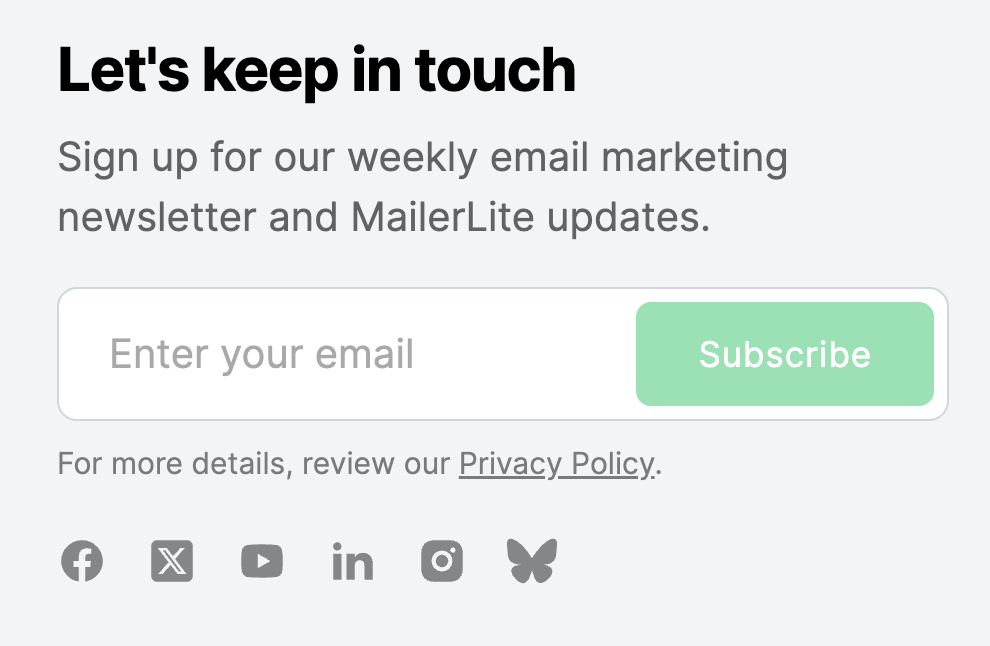
Also, you must tell subscribers what they can expect to receive from you when they share their email address. For example, at MailerLite, we clearly link to our privacy policy at the bottom for anyone who wants to know how we handle personal data.
There’s good news for your existing customer lists: the ePrivacy Directive allows you to email existing customers about similar products or services of yours without fresh consent, provided you gave them a clear opt-out opportunity when you collected their email, and every subsequent email includes an easy unsubscribe. This is narrow, but it means you don’t have to wipe your customer base and start from scratch.
Double opt-in (where subscribers confirm via a follow-up email) isn’t legally required but is one of the best practices to prove consent.
Also critical to remember: under GDPR Article 7(4), marketing consent must be separate from other agreements. You cannot bundle a newsletter opt-in with acceptance of your terms of service.
Consent must be distinct, explicit, and specific for independent choices.
When you use an email platform like MailerLite, you are the data controller and MailerLite is the data processor. GDPR requires a written Data Processing Agreement with every third party that handles your subscribers’ data. MailerLite provides a Data Processing Addendum as part of its Terms of Use. Make sure every other tool you use has a DPA in place too.
Note: If a third-party processor you use is not GDPR compliant, you can be held liable.
Your privacy policy must clearly explain:
If you need to create or update yours to meet GDPR requirements, GetTerms can generate a compliant, plain-language privacy policy tailored to your business.
If you use MailerLite, add this statement to your privacy policy:
“We use MailerLite to manage our email marketing subscriber list and to send emails to our subscribers. MailerLite is a third-party provider, which may process your data using industry-standard technologies to help us monitor and improve our newsletter.
MailerLite’s privacy policy is available at https://www.mailerlite.com/legal/privacy-policy
You can unsubscribe from our newsletter by clicking on the unsubscribe link provided at the end of each newsletter at any time.”
GDPR gives your subscribers 8 key rights you must be ready to fulfill within 1 month of a request:
Note: If you experience a data breach posing a risk to individuals, you have 72 hours to notify your supervisory authority.
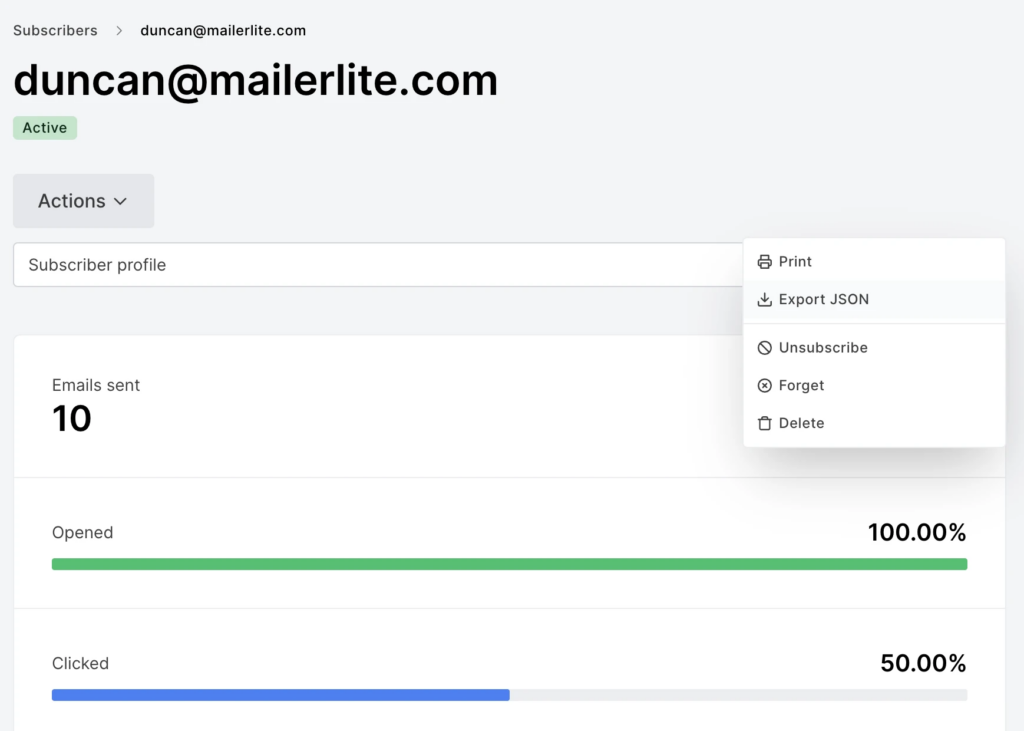
MailerLite is built with GDPR in mind and holds ISO 27001 certification for information security. Key features that support compliance include:
Before building forward, understand where you stand. Ask yourself:
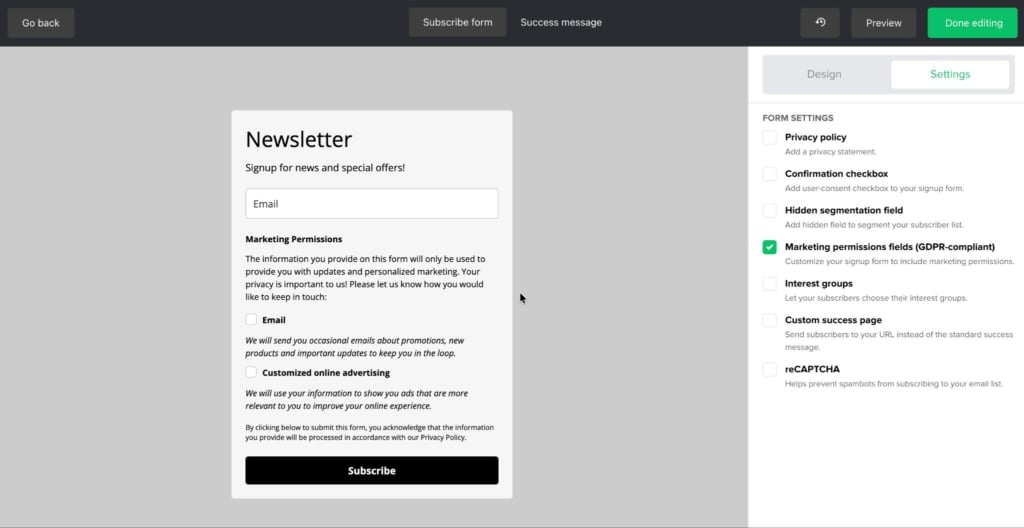
Every signup form must include:
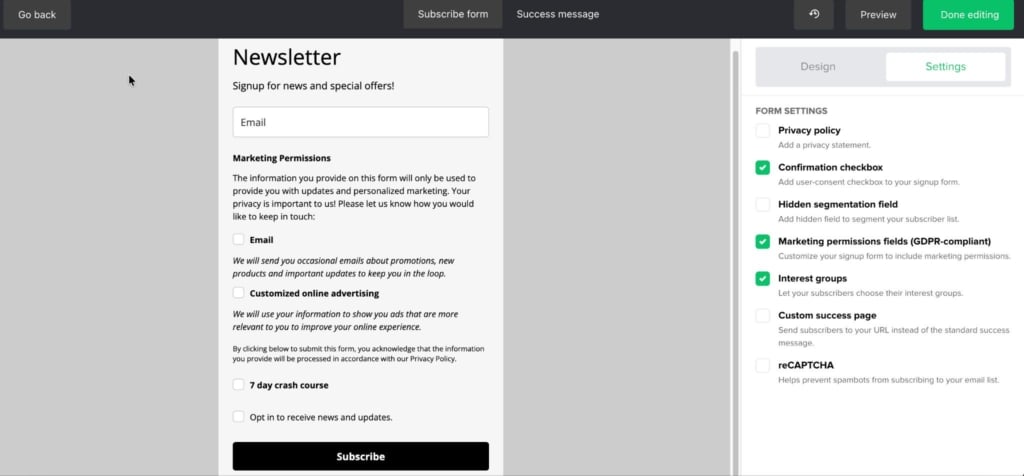
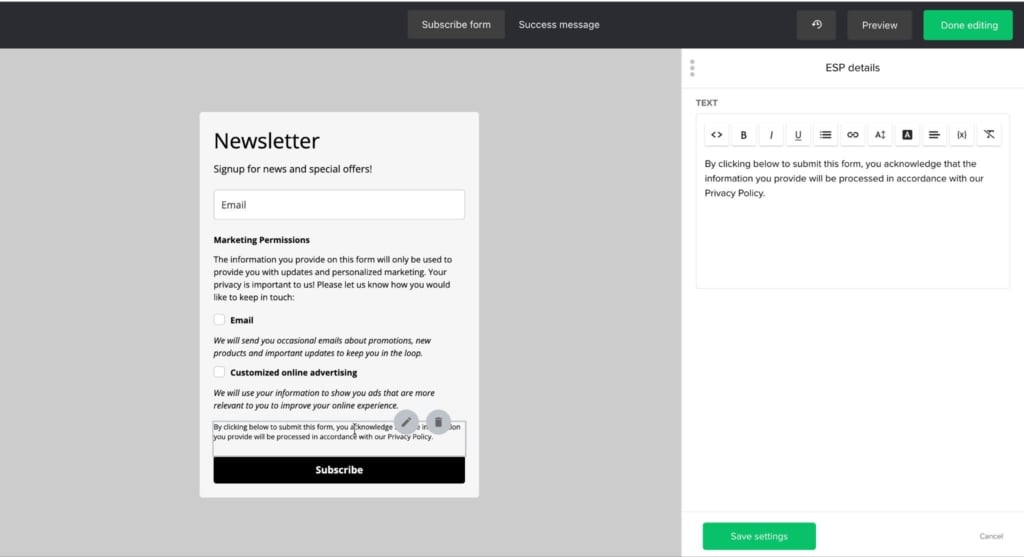
If your existing subscribers gave clear, documented, specific consent that meets GDPR standards, you likely don’t need to ask for consent again. If your consent records are vague, missing, or pre-GDPR, send a re-permission email asking them to actively confirm they want to stay on your list.
For subscribers inactive for 12+ months: run a re-engagement campaign. No response? Delete their data.
Here’s an example of a re-permission email structure:
Example: “We’re tidying up our list to make sure we only send emails to people who actually want them. If you’d like to stay subscribed to [newsletter name], just click the button below. If not, no action is needed, we’ll remove you automatically.”
Send it once. If there’s no response within a set period, say 2 to 3 weeks, delete their data and move on.
Every marketing email must include a visible, functional unsubscribe link. Make it super easy to unsubscribe and avoid hidden links and multi-step processes that violate GDPR and convert would-be unsubscribers into spam complainers.
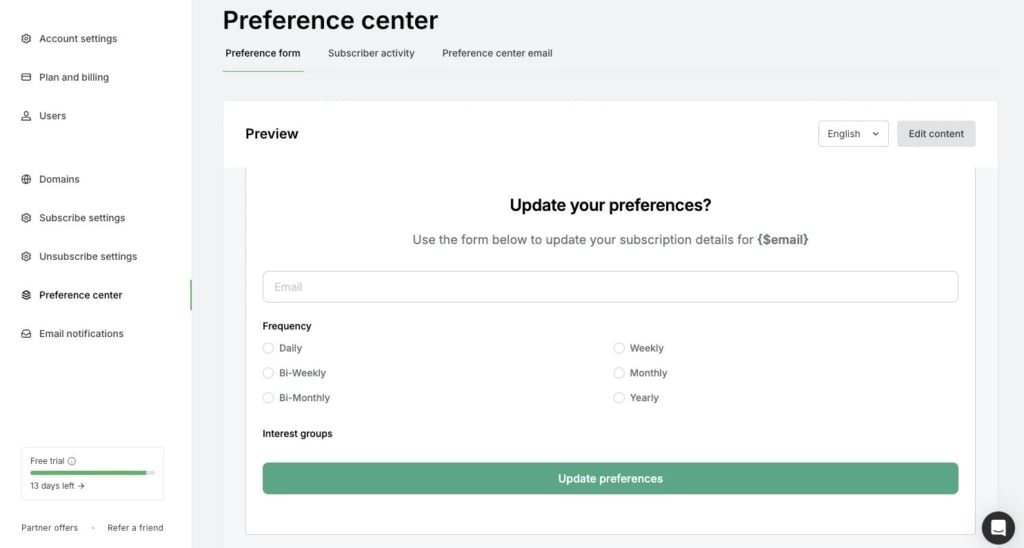
Consider building an email preference centre: a simple page where subscribers can control how often they hear from you and what topics they receive emails about.
It’s a GDPR-friendly tool that gives subscribers real control over their data, and it consistently reduces unsubscribe rates. MailerLite’s built-in preference centre makes this straightforward to set up without any custom development.
Here’s a look at our preference center template:
Use a platform with strong security credentials, enable two-factor authentication on all accounts handling subscriber data, limit access to only those who need it, and have a documented breach response process.
GDPR compliance is a team responsibility, not a solo task. Make sure anyone handling subscriber data understands the basics.
Note on Data Protection Officers (DPO): Organizations that process personal data at large scale are required under GDPR to appoint a formal Data Protection Officer (DPO). Most small and mid-sized businesses won’t meet this threshold, but it’s worth designating someone internally who owns data compliance, even informally.
Here are some traps marketers sometimes fall into and why they’re problematic:
GDPR compliance is an ongoing practice, not a destination. Use this compliance checklist to stay on track:
Consent and opt-in
Email list
Data practices
Privacy and documentation
Security and team
GDPR was built on a simple premise: people should have genuine control over their personal data. When you align your email marketing with that premise: asking only for what you need, using it only for what you promised, and making it easy for people to change their mind, you’re building the kind of marketing practice that earns loyalty when trust is the scarcest resource of all.
A note from the GetTerms team: If you’re just starting out, and in the process of researching email marketing tools, we can only say great things about MailerLite. As a compliance service, we had to be quite picky (okay, VERY picky), and MailerLite’s GDPR-compliant tools gave us confidence, particularly the forget feature, consent tracking, DPAs, and compliant opt-in forms. We recommend giving them a try.
Yes. If you have any subscribers based in the EU or EEA, GDPR applies regardless of where your business is located. When in doubt, treat your whole operation as GDPR-governed.
You need a signed Data Processing Agreement with them. MailerLite provides a Data Processing Addendum as part of its Terms of Use. Check all other tools you use for similar agreements.
There’s no fixed expiry. Consent doesn’t need refreshing on a set schedule, but it can become invalid if your purpose changes, the original consent language was vague, or subscribers have been completely inactive for a long period. Regular list audits are the practical answer.
GDPR has a two-tier structure: up to €10 million or 2% of global annual turnover for less severe violations, and up to €20 million or 4% for the most serious ones. Supervisory authorities can also order you to stop processing data entirely. Reputational damage from public enforcement actions often exceeds the fine itself.
Related but distinct. Cookie Law refers to the ePrivacy Directive governing tracking technologies on websites. GDPR covers all personal data more broadly. They overlap, for example, cookies that collect personal data must comply with both. If you use tracking pixels in your emails or on your site, both frameworks apply.
Technically, yes…but it’s complicated. Cold email is only permissible under GDPR if you can demonstrate a legitimate interest in contacting the recipient, the email is relevant to their professional role or business, and you provide a clear opt-out in every message.
In practice, this is easier to justify in a B2B context (emailing a procurement manager about a relevant service) than B2C. Even where it’s permissible, it’s a legal grey area. If in doubt, build your list through opt-in rather than outreach.
What is WP Consent API and how does it help you keep your WordPress website compliant?
Terms and conditions generator update We’ve completely rewritten the content behind the terms and conditions generator, replacing it with a…