Most countries require websites to have a Privacy Policy (sometimes called a Privacy Notice). We can help with that!
How to make a privacy policy with GetTerms:
Create an account
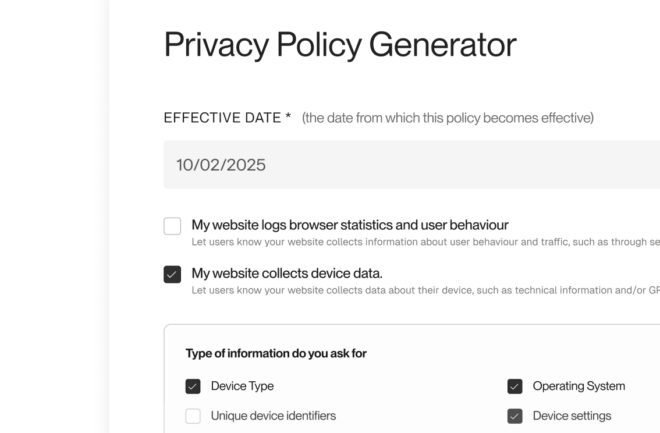
Answer a few simple questions
Get your customized policy instantly
Choose how to use it:
Embed it with a live code snippet
Add it using our WordPress plugin
Use our free hosted version with a direct link
Copy and paste it as html directly into your content editor
Download and upload it as a PDF
You’ll get a clear, professional privacy policy that tells your website visitors how you handle their personal information, building trust while keeping you compliant with privacy laws.
Generate a privacy policy and get a terms and conditions, cookie banner, cookie policy, and more, at no extra cost!
“A No-Brainer! I've had the pleasure of using GetTerms on sites for over a year, and I have been nothing short of impressed!”
Why use GetTerms to generate your Privacy Policy?
It’s simple, we’re the easiest to use tool on the market. We created GetTerms in an effort to make compliance effortless, and affordable for businesses of all sizes. If you want to be sure that you’ve done your due diligence and covered your bases, we designed this tool with people like you in mind.
And hey, if you’re not happy for any reason – simply let us know and we’ll give you a 100% refund. No questions asked.
“If you are looking for a "set and forget" plugin, this is great. 5/5 stars for persistence, technical expertise, and delivering a truly compliant solution.”
Responsive support
Compliance guides
Lifetime deal
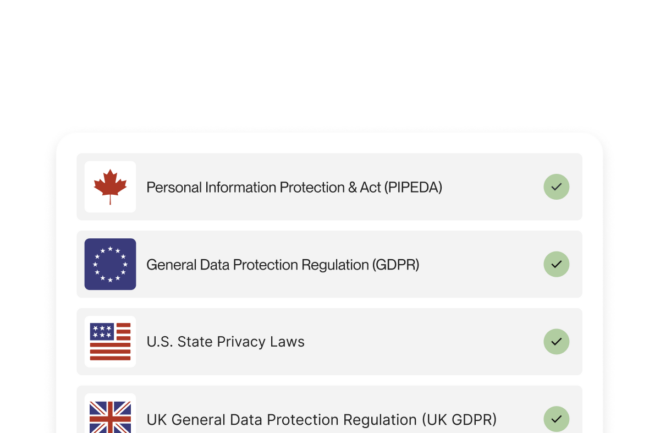
Compliant with global privacy laws
Many countries legally require you to have a privacy policy if you collect personal data from their citizens. GetTerms will get you compliance ready for all of them!
GDPR (EU & UK)
Creates consistent privacy rules across EU countries. Organizations must have clear policies, allow data transfers, and respect people’s right to delete their information.
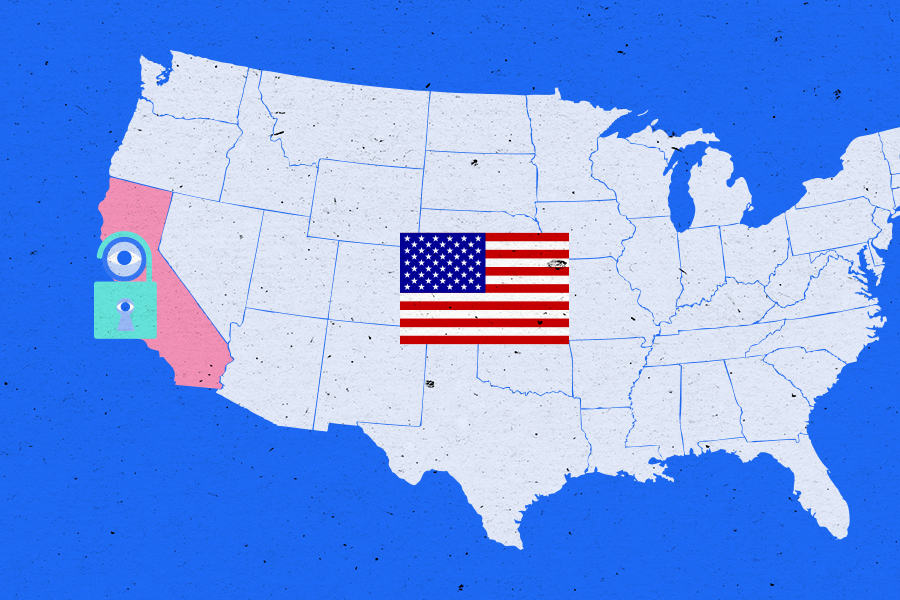
CalOPPA & COPPA (US)
Website operators must clearly display a privacy policy, disclose what personal information is collected, and explain how users can request changes to their data.
PIPEDA (Canada)
Sets rules for private businesses handling personal information, with oversight from the Privacy Commissioner to ensure compliance.
FADP (Switzerland)
Updates Swiss privacy rules to align closely with EU standards, requiring organizations to be transparent about data use and giving individuals stronger rights over their information.
POPIA (South Africa)
Businesses must appoint an Information Officer, process data lawfully across eight defined conditions, notify individuals when collecting their data, and report security breaches to the Information Regulator.
LGPD (Brazil)
Businesses must identify a legal basis for processing personal data, appoint a data protection officer, maintain clear privacy policies, and notify authorities and affected users in the event of a data breach.
Privacy Act (Australia)
Businesses must follow 13 Australian Privacy Principles covering how they collect, store, use, and disclose personal information, and must provide individuals with access to their own data on request.
DPDP Bill (India)
Businesses must obtain clear consent before collecting personal data, appoint a Data Protection Officer, respond to user requests promptly, and report data breaches to India's Data Protection Board.
Over 500,000 privacy policies generated with GetTerms
If you are looking for a "set and forget" plugin, this is great. 5/5 stars for persistence, technical expertise, and delivering a truly compliant solution.
5 out of 5
David A.
I tried Get Terms and I haven't looked back. It has been great for me and my clients.
5 out of 5
Design Stack Studios
There is nothing else like it. This solves a nerve wrecking annoying issue if you're trying to do big things.
5 out of 5
Bobby Scroggins
GetTerms is one of those tools that just works the way you hope it will, and it saved me a ton of time while giving me confidence that my site is properly covered.
5 out of 5
Dexx W.
GetTerms is a must-have! No regrets whatsoever, it's so easy to use.
5 out of 5
Wesley H.
I love the fact that I can have a privacy policy, terms and a cookie banner solution integrated into clients their WordPress website in a blink of an eye!
5 out of 5
Alexander V
Compliance Peace of Mind! There's nothing not to like about GetTerms.
5 out of 5
Mark K
Sep 18, 2019
GetTerms is very easy to use, especially if you don't have any technical website building skills, and I can't say enough about the customer support!
5 out of 5
Scott H
Loving what’s on offer by GetTerms and their support is timely and helpful!
5 out of 5
eXcelebrate
After searching through a bunch of other services, finding GetTerms was a huge relief. Their pricing is fair and transparent, functionality right on point, integration a breeze, and their support was incredibly responsive and helpful.
5 out of 5
Andrew
Honestly, of all the ones I've tried, this is the best. Intuitive and fast, with perfect results. Thank you, thank you, thank you!
5 out of 5
Phillipe
Our privacy policy generator's features
Create a legally compliant privacy policy for any website, app, or business in minutes and save thousands in legal fees. Trusted by thousands, updated automatically as global privacy laws change.
“GetTerms' privacy policy generator is so easy to use, a few clicks and you're done!”
Policy templates reviewed by lawyers
Easy to read
Reviewed by lawyers
Translations available
Always up to date
Compliance with global privacy laws
GDPR + UK GDPR
CCPA/CPRA + CalOPPA
Australian Privacy Act
PIPEDA & more
Easy privacy policy creator
Takes 5 minutes or less
Unlimited edits
Policy hosting & embedding
Simple pricing
Built to suit any business. Integrates with any CMS.
We've helped thousands of businesses get compliant, from startups and small businesses to agencies and enterprises.
Websites and blogs
If you collect personal information (If you use analytics software or contact forms, you do), you are legally required to have a privacy policy. Whether you use WordPress, Wix, Squarespace, or any other CMS, creating a website privacy policy is simple with GetTerms.
eCommerce Stores
Taking the payment details, address, and names of your customers is essential to running an online store. So is a privacy policy. Whether you're using Shopify, WooCommerce, or any other eCommerce platform, use GetTerms quickly generate an privacy policy page for your ecommerce business.
SaaS apps
Trying to run or build a successful Saas App? So are we! We know that compliance isn't as fun as changing the world one product at a time, so leave that to us. We'll generate you a bullet proof privacy policy for your SaaS business that you'll never have to worry about again.
Mobile apps
Developing an App for iOS or Android? Apple's 'App Store' and Google's 'Google Play' both require your app to have a privacy policy in their terms and conditions. Without one, your app may be rejected or removed. Our privacy policy generator makes it easy to meets these requirements.
Our free privacy policy generator is perfect for personal use if you just need a basic privacy policy for your website. You'll enjoy the same easy to use app, without the cost of global compliance.
A privacy policy is a legal document that provides transparency around how an organization handles personal information. It details what personal data the organization collects, how they collect it, how they use it, where they store it, and whether they share the data they collect with third parties or keep it confidential.
If you collect personal information, then yes, you need a privacy policy.
Unlike a terms and conditions statement, a privacy policy is legally required in many countries, including Australia, the USA, and all EU nations.
You’ll also find that many third-party APIs and services require you have a privacy policy. Some services that require a privacy policy are Meta ads and Instagram ads, Google Ad Sense, and the two major commercial app marketplaces: Google Play or the App Store.
Privacy laws govern anyone collecting, storing and using personal information, including governments, companies, and individuals. They give people control over who accesses their personal data, and a way to take action if their data is misused.
Privacy laws also keep companies accountable with significant fines for the misuse, or collection of personal data without consent.
Privacy laws are integral to modern society. As a business, they may seem overly complicated. As an individual, you might think “I don’t care who has my personal data”. But, if you’ve ever been the victim of a data breach or identity theft, you might feel differently.
Privacy is a human right. Data privacy laws protect that right
Personal data (AKA Personal Information) is any information that identifies a person, like their name, email address, IP address, or geolocation data. If your website or app has analytics software installed, or uses a contact form, you collect personal information.
If you collect data from citizens of any of the below countries, you’re legally obligated to have a privacy policy.
Australia
Brazil
Canada
China
France
Germany
Greece
Hong Kong
India
Ireland
Japan
Malaysia
Mexico
New Zealand
Philippines
Russia
Singapore
South Africa
Sweden
Switzerland
Taiwan
Thailand
United Kingdom
United States
Privacy laws only protect citizens of their own jurisdiction, this makes operating nationally fairly simple from a compliance perspective. Things only get complicated when your business grows internationally. For more information, we recommend reading our guide on privacy laws by country.
We don’t recommend copying someone else’s privacy policy.
Firstly, it violates the intellectual property of the company you’ve copied from and may result in legal action.
Secondly, and more importantly, using a policy that doesn’t fit your business puts your company at risk.
Finally, this DIY approach would probably take you longer than generating your privacy policy with a service like GetTerms.
Most online businesses publish a new page specifically for their Privacy Policy, we recommend you do the same. We also recommend linking to the page from the footer as this is where most people expect to find it.
Legally speaking, where you present your privacy policy isn’t incredibly important, as long as it’s easily accessible. You only need to tick a few boxes to stay on the right side of the law.
Your privacy policy must be free.
Your privacy policy must be delivered in a timely manner.
Yes, we have a basic free privacy policy generator to suit simple blogs and personal websites, ideal for individuals. We also offer paid privacy policy templates for businesses, starting at just $5/mo, or $199 for life.
The exact contents of your privacy policy depends on where your users are located. For example, you may need to address requirements of other legal jurisdictions if your users are from multiple countries.
Here are some of the details that most countries require you to include in your privacy policy:
What a privacy policy is
Who you are and your contact information
Why you collect personal data and your legal reasons for doing so
How using users’ information benefits you or others
Who you might share personal information with
If you send users’ information overseas
how you protect user data
How long you keep users’ information (data retention)
Users’ rights regarding their information
Users’ right to change their mind about you using their information
How users can complain if they’re unhappy with how you handle their information
Whether users have to give you their information and what happens if they don’t
If you use technology to make decisions about users automatically, and what this means for them
Please not that these are just guidelines and don’t account for all possible clauses. If you want to ensure your privacy policy is compliance ready for global privacy laws, use our privacy policy generator or consult a lawyer.
While you can use ChatGPT to write your privacy policy, we absolutely cannot recommend that you do so. Here are some reasons why:
A.I. hallucinates a lot, and personally we don’t think anyone should be hallucinating while they write legal documents.
ChatGPT and similar large language models are essentially fancy text prediction systems. They predict the next word in a sequence by looking at the words that came before. This might include some nice grammar and lawyer talk, but a privacy policy is not just about well-written sentences. Compliance with laws like the GDPR in Europe, or the CCPA in California, requires understanding, something A.I. doesn’t have.
Your privacy policy needs to apply to real situations in your company. ChatGPT lacks specific knowledge about your business operations and doesn’t have expertise in privacy legislation. So, while AI can help create a basic structure for a privacy policy, you’ll still need a lawyer review it.
At the end of the day, if you don’t have the expertise to review your legal documents, don’t use A.I. to create them. Instead, use a trusted Privacy Policy Generator like ours. With GetTerms, you can trust that a lawyer has reviewed your policy to ensure it is legally compliant and protects you.
While hiring a lawyer is always going to be the best way to create a privacy policy, it’s also expensive, and in most cases, complete overkill.
A compliant privacy policy’s main goal is to be transparent about how your business handles personal information. It should cover all aspects relevant to your operations and meet the requirements of applicable global privacy laws. A trustworthy privacy policy generator like GetTerms is perfectly capable of this. By asking carefully constructed questions about your business it tailors your policy to perfectly fit your operations.
GetTerms will even keep your policy up-to-date with changing privacy laws. This means you won’t need to pay for extra legal advice every time the rules change. We frequently update our templates to reflect new legal requirements, helping our customers stay compliant without any extra costs.
We update our privacy policy generator several times a year to keep it up to date with global privacy laws.
Learn about privacy policies & data privacy compliance



 Responsive support
 Compliance guides