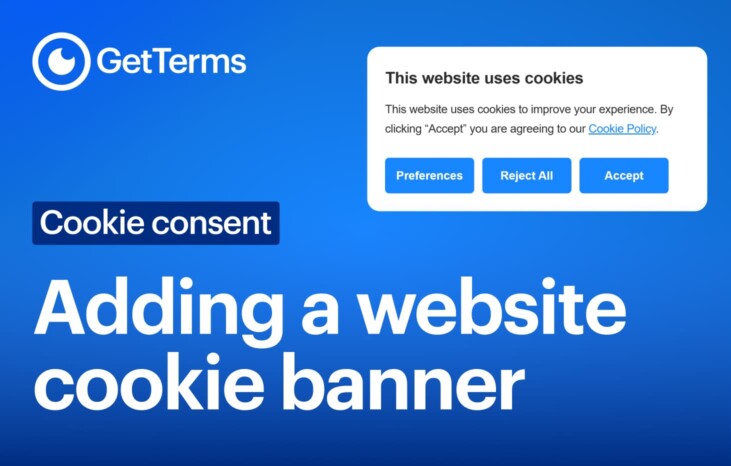
Learn how to create a cookie consent banner with GetTerms. In this guide, we’ll show you how to style, configure, and install a cookie banner on your website.
From the overview page, click the box that says cookie consent banner & cookie policy to start the Cookie Banner setup wizard.
Input your contact details for data privacy related inquiries.
Click Add Cookie Banner & Policy.
Your Cookie Banner has now been generated. GetTerms will automatically start scanning your website for cookies and categorizing them for you.
Customize your Cookie Banner
By default, your Cookie Banner will be set up with our recommended appearance settings and configured for global privacy compliance. If you’re happy with the default appearance settings, you can skip to section 5 to install your banner on your website.
If you’d like to customize your banner’s appearance, let’s walk you through some of the settings.
Font size
Background color
Link text color
Button text color
Button color
Reject all cookies button: Enabled/disabled per-region via the ‘Configuration’ page.
Granular consent controls: Enabled/disabled per-region via the ‘Configuration’ page.
Persistent icon to manage preferences: Enabled/disabled per-region via the ‘Configuration’ page.
Blocking page interaction until preferences are set
This setting encourages your users to set their cookie preferences before they interact with your site. We recommend enabling this if you’re using a discrete banner style, such as the card, banner or pill. Using a discrete banner without blocking interaction may result in your tracking tags not firing and a loss of analytics data.
Configure your Cookie Banner’s behavior
Google consent mode: Enables Google consent mode integration. When enabled you banner will send each user’s consent signals to Google Platforms such as Google Analytics. Follow our setup guide.
Region specific configuration: Set the behavior of your Cookie Banner based on each user’s location.
Script blocking: Blocks cookies and trackers until consent is given. Note: This will cause the page to reload whenever the user interacts with the banner to ensure scripts run correctly.
Reject all cookies button: Adds a ‘Reject All’ to the first layer of your Cookie Banner. This is required in the EU and the UK, and strongly recommended in the USA and Canada.
Global default banner configuration: Set the behavior of your Cookie Banner for users outside of the regions specified in the region specific configurations.
Consent setting: Preset banner behaviors. We recommend leaving this set to the default setting.
Opt-in (Recommended): A preset that blocks cookies until consent is given.
Opt-out: A preset that only blocks cookies if the user withdraws consent.
Custom: Gives you complete control over all settings.
Use global default: Sets the region to follow the settings you’ve configured under ‘Global default banner configuration’.
No banner: Hides the banner for that region.
Persistent icon to manage preferences: Enables the floating icon for reopening the consent modal.
Allow granular consent controls: Enables the preferences button which allows users to consent to cookies based on their individual purpose (Marketing, Statistics, Functional). This is required for most countries, or if you are using Google consent mode.
USA specific settings
Some settings are specific to the United states. These settings control how your banner interacts with Global Privacy Controls.
Respect Global Privacy Control (GPC) signals:The GPC signal allows users to opt out of data sales or the use of their data for cross-context targeted advertising for all sites they visit using a browser plugin.Under the California Consumer Privacy Act (CCPA), sites must respect the Global Privacy Control (GPC) settings of residents of California.
State-specific banner configuration: Set the Cookie Banner behavior for users in California.
Show GPC detection notice?: Enables a message that informs users when their consent preferences are updated to reflect their GPC setting.
Once you’re happy with your banner’s configuration, click Save. As with the appearance settings, it will take about 2 minutes for your changes to display on your live banner. This timer resets each time you update your settings.
Edit your Cookie Banner’s content
From the content page of your dashboard, you can customize all visible text on your Cookie Banner. Content is customizable on a per-language basis, meaning if you make a change to English (UK) it will have no impact on the other translations.
From here, you’ll also be able to change the cookie policy link displayed on your Cookie Banner. By default, we will link to the generated cookie policy, hosted via our website in the relevant language.
Make sure that the language you’re editing corresponds with the banner you’ve installed on your site.
Edit language:
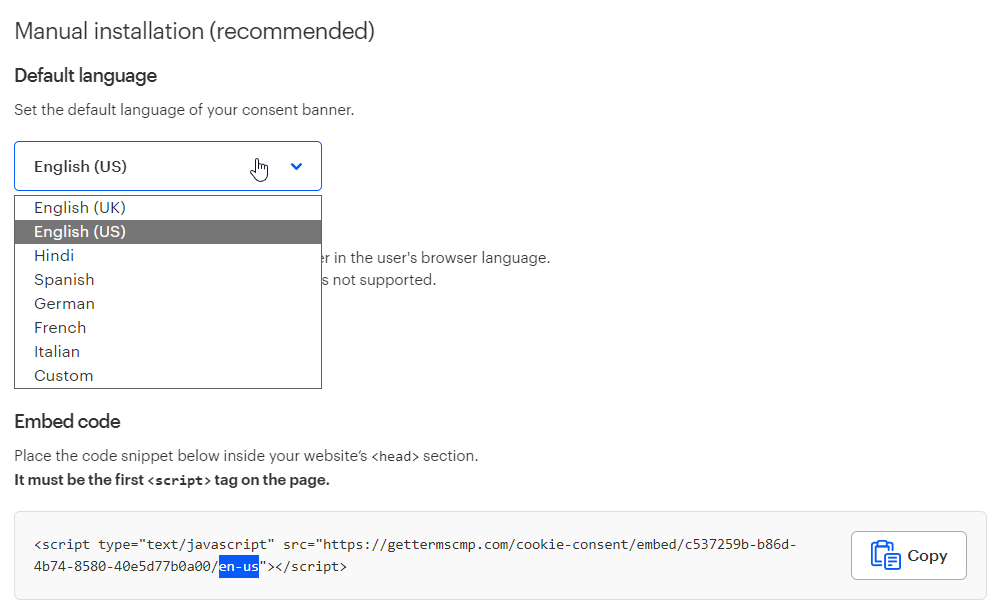
We provide translations for English (UK), English (US), Hindi, Spanish, German, French, and Italian. In addition to this, we allow for one custom translation. Selecting a language from the edit language dropdown menu will open the content fields for the selected language.
This setting does not control the default language of your Cookie Banner. To change the default language your banner displays in, you’ll need to navigate to the installation page.
Click Save at the bottom of the page to save your changes.
Options for installing your Cookie Banner on your website
Once you’ve set up your banner with your desired appearance and configuration settings, you can install it using one of 3 methods.
Manual installation (recommended): Place your banner’s code snippet directly in your website’s <head> section.
Via Google Tag Manager: Install and manage your banner using our Tag Template found in the Google Tag Manager Community Template Gallery. Note: This will prevent script blocking from working reliably.
Installing your Cookie Banner manually using an embed code
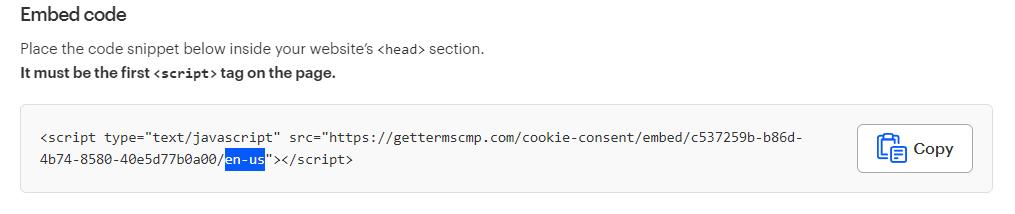
Go to the Installation tab of your consent banner and copy the consent banner embed script.
Paste this code as high in the <head> of the page as possible. It must be the first <script> in the head section of your website and before your Google Tag Manager installation code.
If you’re using WordPress, you must install WPconsentAPI with your cookie banner.
WP Consent API is a plugin that shares your visitors’ consent choices with other WordPress plugins and themes.
Many plugins set cookies in their own way, which can make them hard to control with script blocking alone. Without this extra signal, some plugins may run and set cookies before consent is given.
Installing your Cookie Banner with Google Tag Manager
If neither of the above options work for you, you can install our banner via Google Tag Manager.
Warning: This installation method reduces script blocking reliability and requires Google consent mode to be enabled. We don’t recommend this method unless all your cookie scripts are installed and managed with GTM.
Manage your cookies
While you’ve been setting up and installing your banner, our cookie scanner has been crawling your website, finding any active cookies and trackers and categorizing them for you. Any cookies found on the Cookie Management page, under Active Cookies, will be displayed on the second layer of your Cookie Banner.
You can add, edit, and remove any active cookie using the cookie editor.
Click the dropdown of any of the cookie categories to display the active cookies belonging to the category.
Click Add a cookie to add any cookies not found by our scanner. Cookies behind a login page or cart page may not be visible to our scanner.
Click the pencil icon to open the cookie editor.
Key: The unique name belonging to the cookie (e.g. _ga)
Category: The category belonging to the tracking cookie
Data controller: The name of the company responsible for creating the cookie, e.g. Google
Platform: The platform the cookie is tied to
Domain: The domain that sets the cookie; usually this is your domain
Retention period: How long the cookie stays saved in the user’s browser before expiring
Description: A description of what the cookie does, e.g. setting an ID that identifies unique users
Click Save to save any edits made to a cookie.
Click Back to report to go back to the Cookie Management page.
Click the red subtract/delete button to remove a cookie from the active cookies and place it in the inactive cookies section. Inactive cookies won’t be displayed on your consent banner.
Clicking Restore will place the cookie back in the active cookies section.
Clicking the trash can will remove the cookie from the report entirely. Note: If the cookie is detected in a later scan, it will be re-added to the inactive cookies section automatically.
Make sure your Cookie Banner is working properly
The main functionality of a Cookie Banner is to block scripts when consent for tracking cookies has been denied by the user. You can test whether you Cookie Banner is really blocking cookies using your browsers developer tools.